
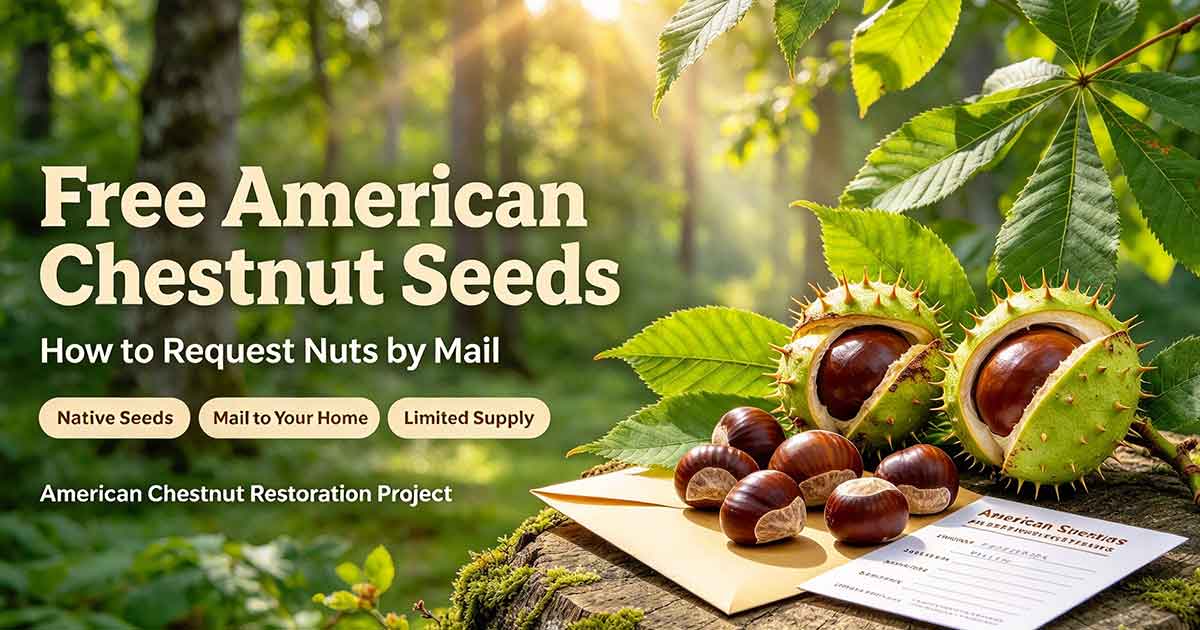
American Chestnut Restoration is mailing free American chestnut seed nuts to anyone who asks. There is no purchase, no membership fee, and no shipping charge. You fill out one short form and wait for an email.
That last part is where most people get this wrong. This is not a two-week sample drop. It is a seasonal conservation program, and the nuts arrive only after the organization emails you to confirm you are ready.
We checked the live form on October 15, 2026. It was open and accepting submissions. Below is exactly what you get, how long the wait is, and the growing steps that decide whether your nuts become trees.
Quick Summary
Item | Details |
|---|---|
Free item | American chestnut seed nuts |
Cost | $0, no membership |
How | Online request form |
Fulfillment | Mailed fall or spring |
Limit | While supplies last |
What Is the Deal
American Chestnut Restoration, Inc. runs a free seed nut program through its official free nuts page. The wording on that page is unusually plain for a freebie offer: the group provides seed nuts to people who request them, free of charge.
Membership is not required. That is stated directly on the official page, and it is the single most misunderstood part of this offer. Members are filled first, and non-members are filled afterward for as long as supply lasts.
The organization contacts you by email in the fall or spring before mailing anything. That email is a confirmation step, not a shipping notice. Your nuts ship only after you confirm you are ready to receive them.
American chestnuts are functionally extinct as a forest tree. A blight fungus imported in the early 1900s killed billions of them, and the species now survives mostly as root sprouts and as breeding stock in orchards. The USDA PLANTS database still lists Castanea dentata as a native species across much of the eastern United States.
ACR vs TACF: Two Groups, Very Different Terms
This is the part every other write-up of this offer gets wrong or skips entirely. Two separate nonprofits work on American chestnuts, and their seed terms could not be more different.
Organization | Terms |
|---|---|
ACR | Free seed nuts; members filled first |
TACF | $40+ membership for seed sale access |
American Chestnut Restoration runs the free program described here. It is small, young, and independent.
The American Chestnut Foundation is the larger national group behind most chestnut breeding. Its regular membership starts at $40 and gets you access to an annual members-only seed sale. The Seed Level membership, at $300, is the tier that unlocks its best research seeds.
So a $0 request and a $300 membership can both get you American chestnut genetics. The catch is that the free route is a waiting game with no guarantee, while the paid route is a purchase with a delivery you control.
If all you want is to try growing one, request the free nuts first. Join a paid membership only if you want the research-grade genetics and the magazine.
What's Free
You receive genuine American chestnut seed nuts, which are the actual nuts rather than a seedling or a tree. The number sent is not published, and the organization does not promise a specific count.
These nuts are pure Castanea dentata. They are not genetically engineered and not hybrids, which means they carry no resistance to chestnut blight. The official page says this plainly, and it matters for your expectations.
A pure American chestnut grown in blight country will most likely get infected and die back before it reaches maturity. Plant it anyway and you are participating in the breeding pool, not harvesting nuts in five years.
The organization is explicit about the intended use. Start a home planting now, then pollinate your trees later once blight-tolerant trees are publicly available from SUNY ESF, or plant one among yours to produce your own resistant nuts.
There is also a nut exchange at the annual meeting. Members who have surplus nuts bring them, and all attendees are welcome to take nuts for their own plantings.
What Changed in 2026
The blight-tolerant chestnut moved closer to public release this year. On August 28, 2026, USDA's animal and plant health agency published its determination that the Darling 54 American chestnut is no longer a regulated article.
That is the line from the Federal Register notice, and it is the first time a genetically engineered tree has cleared this step specifically for ecological restoration. The official PDF version carries the same date.
One wrinkle worth knowing. The tree was filed for years as Darling 58, and the name was corrected to Darling 54 after a labeling error surfaced in 2023. Old articles still use the wrong name.
Deregulation is not distribution. The Environmental Protection Agency still has to finish its own review, and the ESF progress report describes that process as complex because no wild tree has been through it before.
ESF says initial distribution will likely start with expanded research plantings and could include citizen scientists within about a year. That is why planting pure nuts now is a rational move: you would have rootstock ready when resistant pollen is finally available.
How to Claim Step by Step
Go to the official free nuts page on americanchestnut.org.
Read the eligibility text, especially the blight warning, before you fill anything in.
Complete the embedded request form on that page. It asks for contact details and a mailing address.
Submit and watch for a confirmation. Do not submit twice if you do not see an instant response.
Wait for the organization's email in fall or spring asking you to confirm you are ready.
Reply promptly. Slow replies are the most common way people lose their place in line.
Receive your nuts by mail and refrigerate them right away.
That seventh step is not optional. Chestnut nuts lose viability fast if they dry out or sit at room temperature.
What to Do When the Nuts Arrive
Most failures happen after the free part, not during it. Chestnuts are recalcitrant seeds: they die if they dry out, and they die if they freeze.
Cold stratification is mandatory. Store the nuts at 34 to 40 degrees Fahrenheit in a moist medium such as damp peat, sphagnum, or vermiculite. Sixty to ninety days is the normal window, and the vegetable crisper drawer usually does the job.
Keep them away from fresh fruit. Ethylene from apples and similar produce can push chestnuts to ripen too fast and spoil the batch.
Expect a root tip to appear during cold storage. That radicle is fragile. Plant with it pointing down or sideways, and do not handle sprouted nuts roughly.
Use a deep container. Chestnuts throw a long taproot in year one, so a tall narrow pot or a cut-down milk carton beats a shallow tray.
Plan for rodents. Mice, squirrels, and chipmunks treat chestnuts as a prize. Hardware cloth over the planting bed is not optional in most yards.
Give them acidic, well-drained soil. A pH between 4.5 and 6.5 is the target, and standing water will kill a young seedling faster than blight ever will.
Finally, plant more than one. American chestnuts cannot pollinate themselves, so two or more trees are required before any of them set nuts.
Who Is Eligible
Anyone can request. There is no membership gate, no age minimum published, and no proof of land ownership required by the form.
Requests are open to United States addresses. The organization does not describe an international shipping option on the official page, so treat this as US-only unless you hear otherwise by email.
Members get priority. If you are serious about planting and supply is tight, joining the organization both improves your odds and funds the work.
Landowners in the historic chestnut range have the strongest case for planting. That range runs through the Appalachians and the eastern hardwood forest, roughly USDA zones 4 through 8.
Important Fine Print
Supply is limited and depends on demand. The organization states it will send nuts to as many non-members as possible but may run out. There is no guarantee attached to a non-member request.
Fulfillment is seasonal, not fast. If you submit in October 2026, the realistic shipping windows are late fall 2026 or spring 2027. Anyone promising two-week delivery is describing a different program.
The nuts are not blight resistant. This is the restriction that surprises people most. Expect most pure American chestnut seedlings to eventually succumb to blight in the East.
You will get an email before mailing. If you miss it or let it sit in spam, your request can silently fall off the list. Check spam folders from the submission date onward.
Do not request nuts you have no plan to plant. This is a conservation program with real postage and labor behind every package.
Frequently Asked Questions
How much do the free chestnut seeds cost?
Nothing. There is no purchase, no shipping fee, and no membership requirement. The official page states that nuts are provided free of charge to people who request them.
Do I need to become a member to get nuts?
No. Membership is not required, but members are served first. If supply is short, members are filled before non-members, and non-member requests may go unfilled.
When will my free chestnuts actually arrive?
Plan on fall or spring. The organization emails you before mailing to confirm you are ready, then ships. A request submitted in October 2026 most likely lands in late fall 2026 or spring 2027.
Can I grow a blight-resistant tree from these nuts?
No. These are pure American chestnuts, not hybrids and not genetically engineered, so they have no blight resistance. They are breeding stock and home-planting material, not a guaranteed survivor.
What does it take to germinate chestnut seeds?
Cold, moist stratification. Store nuts at 34 to 40 degrees Fahrenheit in damp peat or vermiculite for 60 to 90 days, then plant the nut half an inch to one inch deep with the pointed end down.
Is this offer available outside the United States?
The official page does not describe international shipping. Treat it as US-only, and if you are outside the US, contact the organization before assuming a request will be honored.
Similar Deals Worth Checking Out
The free AESTURA skincare sample program, which runs on the same first-come structure.
Free Sampliful bath soak samples mailed while supplies last.
The soils.org free sticker, a nonprofit mail-out for soil and conservation fans.
MoveOn's free sticker, another no-cost nonprofit request.
The free 2027 family calendar mail-out if you want more by-mail freebies with no purchase.
About American Chestnut Restoration
American Chestnut Restoration, Inc. is a 501(c)(3) nonprofit dedicated to restoring the American chestnut. Its EIN is listed publicly as 16-1369777 on its own site.
The organization was formerly the New York chapter of The American Chestnut Foundation and became independent under its current name in 2025. The SUNY ESF chestnut project confirms the rename and notes that the group already has members in more than 15 states.
ESF runs the transgenic research program that produced the Darling line of blight-tolerant chestnuts. Its Spring 2026 progress report describes regulatory progress and continued collaboration with the renamed American Chestnut Restoration.
Sources & References
Free American Chestnut Seed — official request page — program terms, membership priority, blight warning, and request form.
American Chestnut Restoration home page — nonprofit status and EIN.
Growing Chestnuts — official guidance — organization's own planting notes.
Chestnut Identification — how to tell American chestnut from lookalikes.
SUNY ESF American Chestnut Research and Restoration Project — transgenic research program overview.
ESF page on American Chestnut Restoration — organizational history and rename.
ESF Spring 2026 progress report — current regulatory status.
USDA PLANTS profile for Castanea dentata — official species and native range data.