
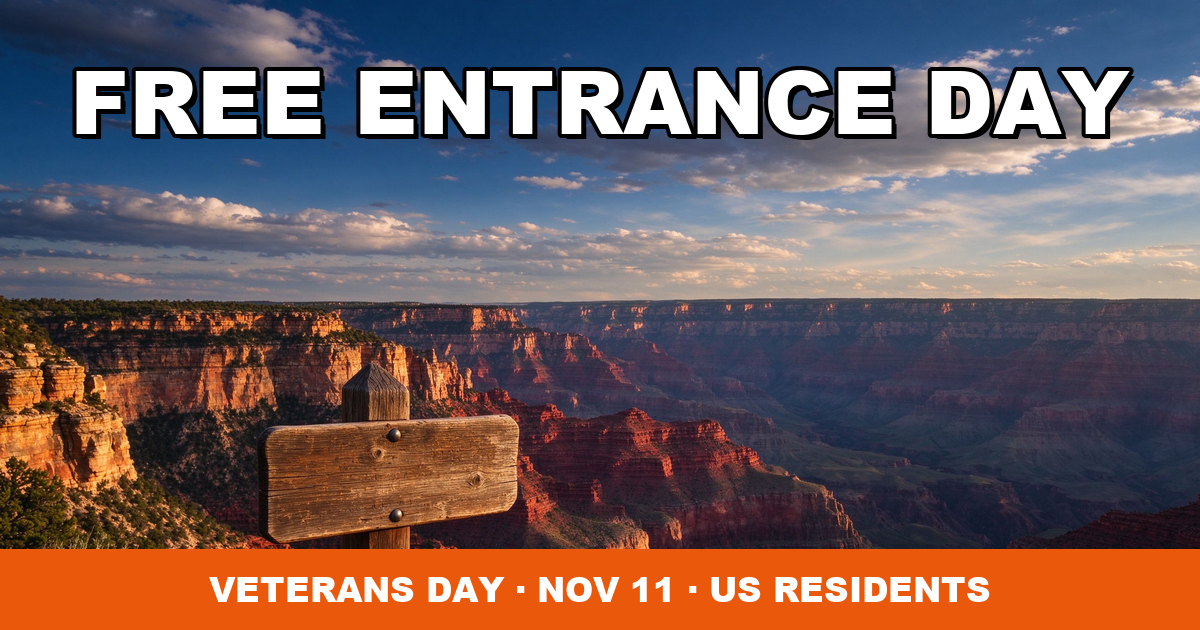
Every November, the National Park Service waives entrance fees at its fee-charging parks to honor Veterans Day. In 2026, that free-entrance window falls on Wednesday, November 11 — a single calendar day where you can walk through the gates at more than a hundred parks without paying the standard per-vehicle or per-person fee.
But 2026 brings an important change. Starting this year, the NPS free-entrance days are limited to U.S. citizens and permanent residents only. Foreign visitors traveling from abroad will still owe the standard entrance fee plus a separate nonresident surcharge at eleven of the most popular parks. If you are planning a November road trip to a national park, you need to know this rule before you go.
This guide breaks down exactly which parks are free, which ones still charge extra fees for nonresidents, what time the gates open in every U.S. time zone, and what happens if you miss the November 11 window entirely. We also compare this Veterans Day free day to the other free entrance days that have already passed in 2026, so you can plan ahead for 2027.
Whether you are a local trying to squeeze in a weekday hike or a family road-tripping across the West, read on before you load the car. The savings can add up fast — a single vehicle pass at parks like Grand Canyon or Yellowstone normally runs $35, and a week-long Southwest road trip through Zion, Bryce, and Grand Teton can easily cost $100 or more in combined entrance fees.
Quick Summary
Detail | What You Need to Know |
|---|---|
Date | November 11, 2026 (Wednesday) |
Fee waived | Entrance / admission fee only |
Eligibility | U.S. citizens and residents |
Nonresidents | Pay entrance fee + $100 surcharge |
Parks affected | Fee-charging NPS sites only |
Next free day | February 15, 2027 (Presidents Day) |
What Is the Deal
On Veterans Day, the National Park Service waives all standard entrance fees at parks that normally charge them. The waiver applies for the entire calendar day of November 11, 2026, from the moment each park opens its gates in the morning until it closes for the night.
This is one of five free entrance days the NPS designates each year. The 2026 schedule included the spring equinox, National Public Lands Day, a couple of smaller commemoration days, and now Veterans Day as the final free day of the year. The next one on the calendar is Presidents Day on February 15, 2027.
In 2026 the NPS added a new restriction that has caused some confusion. Free entrance days are now reserved for U.S. citizens and legal permanent residents. Visitors who are neither citizens nor residents must pay the regular entrance fee plus a separate nonresident fee of $100 per person at eleven specific high-demand parks.
This is a policy shift from previous years, when free entrance days applied to everyone regardless of nationality.
The National Park System covers 475 sites across the United States and its territories. Only about a hundred of those sites actually charge an entrance fee. The rest — national monuments, historic sites, parkways, and recreation areas — are already free year-round. So on Veterans Day, the free entrance benefit matters most at the fee-charging parks that you would otherwise have to pay to enter.
For the full list of fee-free parks and official policy details, visit the NPS Passes page.
What's Free
The only thing waived on November 11 is the standard entrance fee — sometimes called the admission fee or day-use fee. At most parks this is charged per private vehicle and covers everyone in the car for seven days. At a handful of parks that use per-person pricing, it is charged per hiker or cyclist.
What is not free on Veterans Day:
Parking fees. Many parks now charge separate parking fees, especially at trailheads and popular viewpoints. These are not waived.
Timed entry reservations. Parks like Rocky Mountain, Acadia, and Glacier require a separate timed entry permit during peak season. The permit fee is not waived even on free entrance days.
Camping fees. Campground reservations still cost the normal nightly rate.
Tour fees, shuttle fees, and concession-operated activities. Guided tours, boat rentals, horseback rides, and paid shuttle services all charge their regular prices.
Annual passes. The $80 America the Beautiful Pass is still sold at the usual price on free entrance days. If you already own one, you were already getting in for free anyway.
The eleven parks that impose the $100 nonresident surcharge are: Acadia, Zion, Grand Canyon, Yellowstone, Yosemite, Glacier, Bryce Canyon, Everglades, Grand Teton, Rocky Mountain, and Sequoia-Kings Canyon. If you are a non-U.S. resident planning to visit any of these parks on November 11, budget accordingly — the total cost will be the regular entrance fee plus the $100 per-person surcharge.
How to Claim Step by Step
You do not need a coupon, a code, or a printed voucher to get in free on November 11. The process is straightforward:
Pick your park. Use the NPS fee-free days page to confirm which parks are waiving fees on Veterans Day.
Check timed entry requirements. Some parks require a separate reservation even on free days. Book well in advance if needed.
Arrive at the park gate. Drive up to the entrance station as you normally would.
Tell the ranger you are visiting on fee-free day. They will confirm the waiver and wave you through. No ID is needed unless you look like you might be a nonresident — in that case, carry proof of U.S. citizenship or residency.
Pay for anything else. If you want parking, camping, or a tour, those are charged separately at the normal rate.
Enjoy the park. The free entrance covers the whole day, and your receipt is not needed for re-entry because there is no fee to waive.
Who Is Eligible
The free entrance on November 11 is open to everyone in the vehicle if the driver or a passenger qualifies. But the 2026 rule change means the eligibility standard has shifted.
U.S. citizens get in free at all fee-charging NPS parks on November 11.
Legal permanent residents (green card holders) also qualify for the free entrance.
Visitors on tourist visas, student visas, or any other non-immigrant status do not qualify for the free entrance waiver. They must pay the regular entrance fee and, at the eleven surcharge parks, the additional $100 nonresident fee per person.
If you are traveling in a car with a mix of U.S. residents and non-residents, the entrance fee for the vehicle is waived as long as at least one qualifying person is present. However, the nonresident surcharge at the eleven high-demand parks is charged per person, so each nonresident in the vehicle would still owe the $100 fee.
This is a new policy for 2026 and has been discussed in coverage from national news outlets. If you are unsure about your status, check the official NPS guidance before you travel.
Important Fine Print
A few details are easy to miss and can turn a free day into an expensive surprise.
First, the free entrance applies only to the entrance fee. If your chosen park has a separate timed entry permit system — Rocky Mountain, Acadia, Glacier, and Haleakala all do during busy seasons — you still need to book that permit and pay the permit fee. Veterans Day falls on a Wednesday in November, which is typically past peak timed-entry season, but it is worth double-checking the park official website to be sure.
Second, the $100 nonresident surcharge is per person, not per vehicle. At Grand Canyon or Yellowstone, a family of four visiting from abroad would owe four times $100 on top of the regular entrance fee. For nonresident travelers, a standard seven-day vehicle pass is often the better deal than paying individual surcharges.
Third, free entrance days at national parks are extremely busy. November 11, 2026 is a Wednesday, which helps. But the most popular parks — Grand Canyon South Rim, Yellowstone, Yosemite Valley — will still see heavier traffic than a normal November weekday. Arrive early, pack patience, and expect parking lots to fill up by mid-morning.
Fourth, if you already own an America the Beautiful Pass ($80 annually), you were never paying entrance fees anyway. The free day does not give you any additional benefit beyond what your pass already covers. But it is a great day to visit a park that you normally would not drive out of your way for.
Fifth, the free entrance does not apply to parks managed by other agencies. U.S. Forest Service, Bureau of Land Management, and U.S. Fish and Wildlife Service sites have their own free day schedules.
For example, the recent USFWS National Wildlife Refuge free entrance day was a separate event on October 11.
Frequently Asked Questions
Do I need to show ID to get in free on Veterans Day?
In most cases, no. The entrance fee waiver is applied automatically at the gate on fee-free days. However, because 2026 is the first year the NPS has restricted free entrance days to U.S. citizens and residents, some entrance stations may ask for proof of status if they suspect a visitor is a nonresident.
Carry a driver license, passport, or green card just in case. For the full policy text, see the official NPS fee-free days announcement.
Which national parks are busiest on Veterans Day?
The South Rim of the Grand Canyon, Zion Canyon, Yosemite Valley, and Yellowstone Lower Loop are typically the most crowded on fee-free days. November weather at higher-elevation parks like Rocky Mountain and Glacier can be cold and snowy, which keeps crowds down.
If you want a quieter experience, try a lesser-known park like Great Smoky Mountains (which is already free year-round) or one of the national monuments that does not normally charge an entrance fee.
What happens if I already bought an America the Beautiful Pass?
If you already own the $80 America the Beautiful Annual Pass, you were not paying entrance fees at any NPS site to begin with. The Veterans Day free entrance does not give you any extra perks — your pass already covers entrance fees at more than 2,000 federal recreation sites.
That said, free entrance days are still a great excuse to visit a new park. You can check the pass options on the NPS passes page.
Are national parks open on Veterans Day?
Yes. National parks are open every day of the year except December 25. Veterans Day is a federal holiday, which means NPS headquarters offices and visitor centers may operate on reduced staffing schedules, but the parks themselves remain open.
Some facilities may have shorter hours or be closed entirely on November 11, so check your specific park operating hours before you go. The NPS operating hours directory has up-to-date information.
Can I bring my dog to a national park on free entrance day?
Dogs are welcome in most national parks, but they must be leashed at all times and are not allowed on most trails, in most backcountry areas, or inside most historic buildings. The free entrance does not change pet rules. If you plan to hike with your dog, check whether the park you are visiting allows pets on trails. The NPS pets page has a park-by-park guide.
What if I miss the November 11 free day?
The next NPS free entrance day after Veterans Day 2026 is Presidents Day, Monday, February 15, 2027. That is a long wait if you were hoping for a fall or winter trip. Alternatively, the $80 America the Beautiful Pass pays for itself if you visit just three or four fee-charging parks in a year.
You can also look for free admission days at other cultural institutions — the Museums on Us program offers free museum admission the first full weekend of every month for Bank of America cardholders.
Similar Deals Worth Checking Out
If you are taking advantage of Veterans Day to get out and explore, there are other military-appreciation deals happening on the same day that pair well with a national park trip.
Twin Peaks is offering a free entree for active and retired military on November 11, and Golden Corral is hosting its annual Military Appreciation Night the same evening.
Earlier this fall, we covered the Theodore Roosevelt Birthday free entrance day on October 27 — the last free entrance day before Veterans Day. If you are already mapping out your 2027 national park trips, add Presidents Day on February 15 to your calendar now.
About the National Park Service
The National Park Service is an agency of the U.S. Department of the Interior that manages all national parks, most national monuments, and other natural, historical, and recreational properties. It was created on August 25, 1916, through the National Park Service Organic Act signed by President Woodrow Wilson.
As of 2026, the NPS oversees 475 sites covering more than 85 million acres across all 50 states, the District of Columbia, and U.S. territories.
The agency mission is to preserve unimpaired the natural and cultural resources of the National Park System for the enjoyment, education, and inspiration of this and future generations. More than 320 million people visit national park sites each year, making the NPS one of the most-visited public land management agencies in the world. You can learn more on the NPS Wikipedia page.